Automatic IP Address Checks to Avoid Allocation Conflicts
"This address is offline right now. Can we use it for the new server?"
Before a new device goes live, Chen, the engineer responsible for allocating addresses, pauses at this question. The spreadsheet lists no user, and the candidate address shows no sign of being online. But he still cannot tell whether the original device has been retired or is temporarily powered off and expected to return.
He needs to give the deployment team a clear answer. Allocating the address immediately could lead to duplicate use when the old device returns. Searching asset records, reviewing chat history, and contacting people one by one would delay preparations for the deployment.
In this simplified allocation scenario, automatic address checks aim to improve that confirmation process: bring registration records, assets, and observed subnet status together so operations teams can find evidence faster and address signs of existing use or conflicts before allocation.

Offline Does Not Mean Released
Chen first needs to establish whether the address has an existing allocation. A device going offline and its business owner agreeing to release the address are two separate things.
Suppose the original device is being repaired and will still need its address when it returns. Being offline has not changed its allocation. If the registration record is missing, the next person handling the address could easily combine "no user listed" with "no sign of being online" and reach the wrong conclusion.
These two pieces of information appear to support each other, but both may be incomplete: one omits the allocation decision, while the other reflects only what is currently observed.
Before allocation, establish both who the address has been assigned to and what status is currently observed.
This gives automatic checks a concrete purpose. They should reduce Chen's need to search across spreadsheets and help him identify what needs confirmation sooner. The intended use of an address still needs to be preserved in a record.
Check Each Step of the Allocation Process
1. Confirm the Management Scope
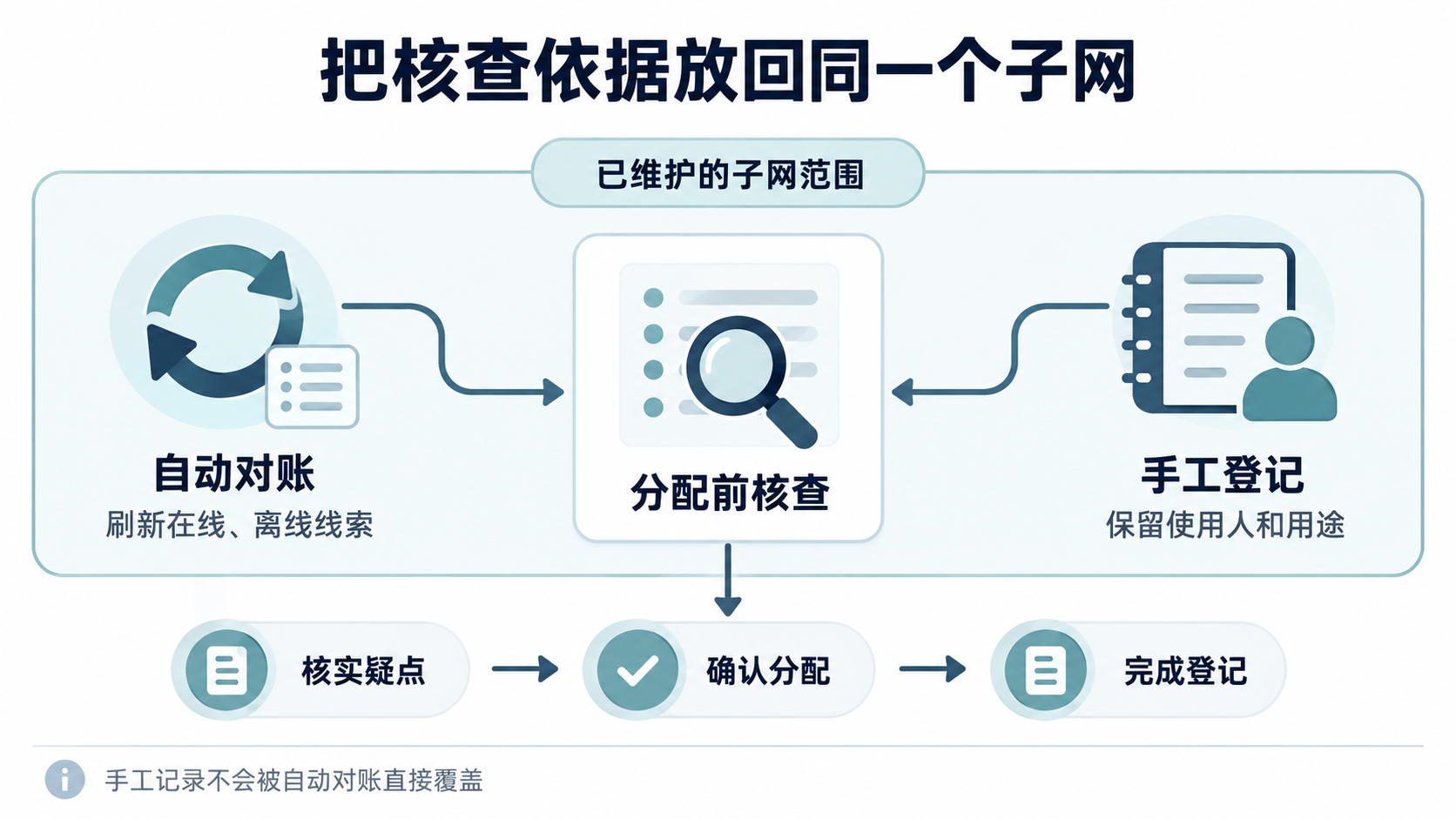
Chen is preparing to allocate an address in the target device's subnet. He first needs to confirm the subnet boundaries and the address range already maintained before interpreting the check results.
Reconciliation within a subnet has a defined scope. If the boundaries are incomplete and some objects are outside that scope, the available results cannot establish that every candidate address has been checked.
Finding no issues within the reconciliation scope does not establish the same for addresses outside it. In day-to-day address management, confirming the scope is a prerequisite for interpreting automatic check results correctly.
This narrows Chen's question: instead of asking generally whether any addresses are left, he checks capacity and specific candidates within a defined subnet.
2. Review Status and Registration Records
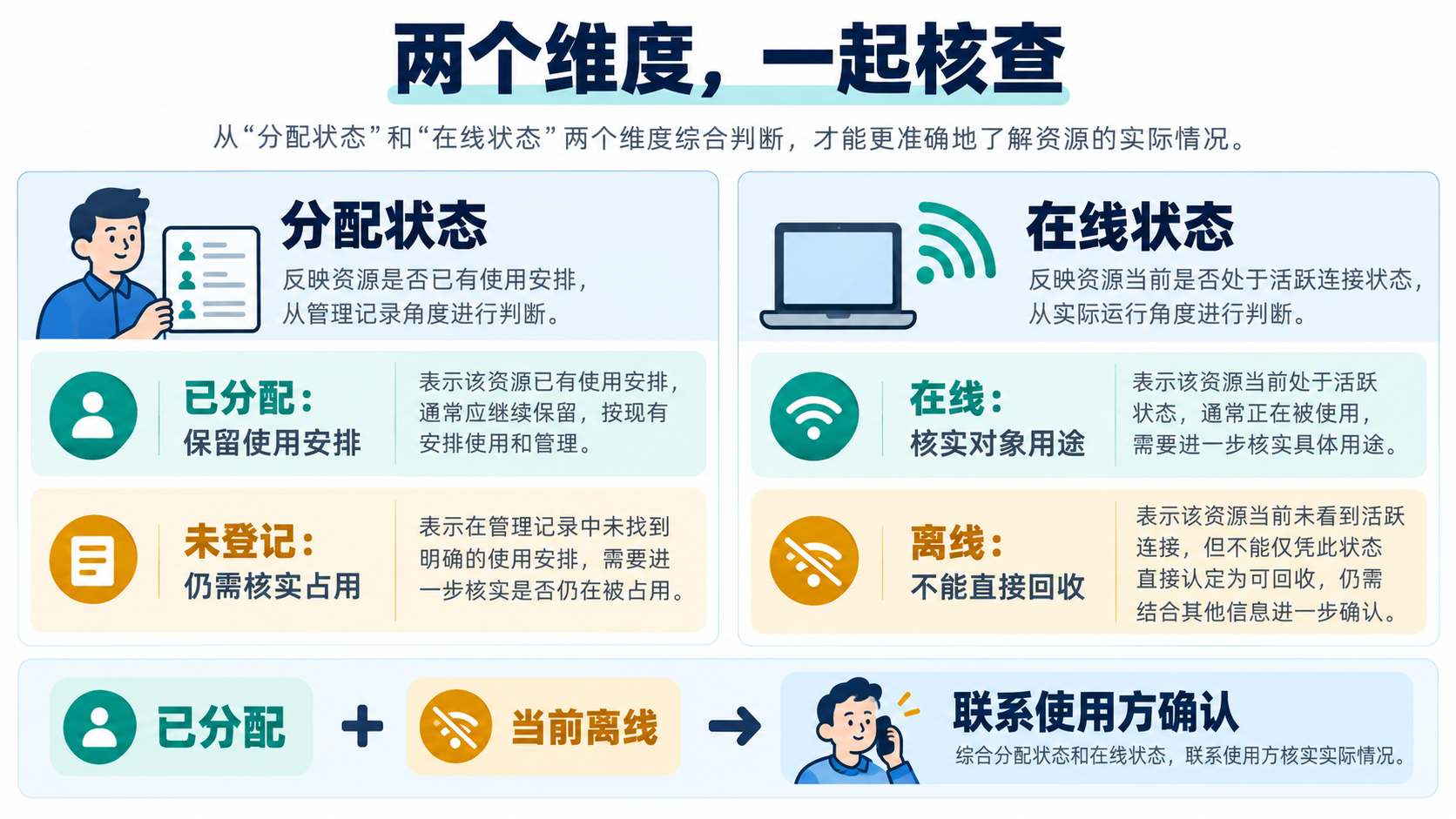
After finding a candidate address, he needs to understand its allocation status and online status separately.
Allocation status records the intended use: which device or service has the address and who maintains it. Online status reflects current observations and provides clues that may need further investigation.
Together, they point to specific follow-up tasks:
| Candidate address situation | What Chen needs to confirm next |
|---|---|
| Registered as in use, currently offline | Whether the current user still needs it and whether it can be released |
| No registration record, but an online object is detected | What the object is used for and who should complete the record |
| Conflict or unknown status | Whether the issue has been investigated and allocation should be deferred |
This changes the amount of work involved. Chen no longer needs to ask about every address from scratch. He can use the available clues to contact the relevant users and resolve specific uncertainties.
If the user replies that the device will return after repairs, the candidate address should remain reserved. But if that answer stays only in a chat, the same question will come up during the next allocation.
3. Record the Confirmed Allocation
Chen then needs to add the user and purpose so others can understand why the address is offline and why it cannot yet be reclaimed.
This information cannot be reliably inferred from status refreshes alone. Automatic checks can provide new clues, but they cannot decide on behalf of the business owner whether an existing allocation has ended.
When manual records disagree with observed status, investigate the specific object further. After a device has actually been retired or migrated, confirm that the original address has been released before updating its record. Keeping records also means maintaining them over time.
The investigation now has a connected set of evidence: a confirmed scope, a comparison of observed status with allocation records, and the user's confirmation written back to the register. The next colleague can see why the address needs to remain reserved.
Technical Insight: Keep Both Types of Evidence
In address management, observed status and intended allocation have different sources of updates. The former needs ongoing observations; the latter needs confirmation and maintenance by the responsible person.
If only online status is retained, an offline device's address may be reclaimed by mistake. If only manual records are retained, actual changes may go unnoticed for a long time. Keeping both makes inconsistencies visible and actionable.
To assess whether automatic checks are useful, look beyond refresh frequency and consider whether they improve allocation decisions:
- Can existing use or signs of an issue be found before an address is handed over?
- Can the reason an offline device still needs its address be preserved?
- Can the user and purpose still be found after multiple handovers?
This information lets operations teams focus on objects that need a decision and makes each confirmation reusable in later work.
Reduce Repeated Confirmation With Subnet Reconciliation
WeOpsX CMDB supports this checking process through its subnet IP view and IPAM subnet management. It brings capacity, status, and usage information that was previously scattered back into a single management scope.
View Capacity and Issues Together
The subnet IP view shows total, used, and remaining address counts and utilization, along with statuses such as online, offline, conflict, and unknown.
Chen can first assess the target subnet's capacity, then inspect candidate addresses. Existing records and abnormal statuses help narrow the investigation, reducing repeated switching between spreadsheets, asset records, and messages.
The remaining count provides a capacity reference. Whether a specific address can be handed over still depends on existing records and its actual use. The scannable range, visible fields, and status categories depend on the product interface and local configuration.
Keep Observations Updated by Subnet
IPAM continuously refreshes online and offline status by subnet, and automatically maintained address records are updated during reconciliation. Subnet boundaries, including CIDR information, need to be maintained before use. Automatically discovered hosts, network devices, and other objects enter the reconciliation scope according to their subnet.
Periodic reconciliation maintains status during routine operations. Before and after device deployment, migration, or address changes, a reconciliation can also be triggered manually for an individual subnet to provide additional evidence for the current check.
Only addresses defined within the subnet participate in reconciliation. Objects outside the scope do not overwrite that subnet's records. Chen therefore still needs to check the target scope first and avoid treating a local result as a conclusion about the entire network.
Save Confirmed Allocation Details
WeOpsX supports manually maintaining allocation status, address type, user, MAC address, description, and other information. Manually maintained records are not directly overwritten by automatic reconciliation.
For a device undergoing repairs, Chen can record the address's purpose and user. When the next colleague sees an offline status, they can find the responsible person and understand why the address remains reserved.
Registration must be completed by someone with asset editing permissions. Viewing or selecting a free cell does not automatically create a register entry. A selection in the interface should not be treated as a completed allocation.
Practical Checks Before Handing Over an Address
Returning to the new device deployment, Chen needs to do more than hand over an address. He also needs to complete the related confirmation and registration. The following order can help:
- Confirm the scope. Are the target subnet, boundaries, and maintained address range correct?
- Update the evidence. Have reconciliation results been reviewed, and is a manual check needed before or after the change?
- Resolve uncertainties. Have allocations been confirmed for addresses that are offline but assigned, in conflict, or unknown?
- Coordinate allocation. Is the team's shared process being followed to prevent multiple people from assigning the same address at the same time?
- Complete registration. Have the user and purpose been recorded, and has the actual configuration been checked?
Allocation coordination needs explicit attention. IPAM's checking and registration capabilities do not constitute automatic address assignment or an exclusive lock. If two people handle the same address simultaneously, a shared process is still needed to coordinate their work.
When a device is later migrated or retired, confirm that the old address has actually been released before updating the record. Otherwise, today's allocation details can become an obstacle to the next decision.
The improvement from automatic checks should be visible in daily work: existing use is easier to confirm, uncertainties are investigated before deployment where possible, and allocation details remain available after handover. Less guesswork during address allocation means fewer avoidable repeated checks and allocation conflicts for the team.